
You can watch the full report on : Youtube
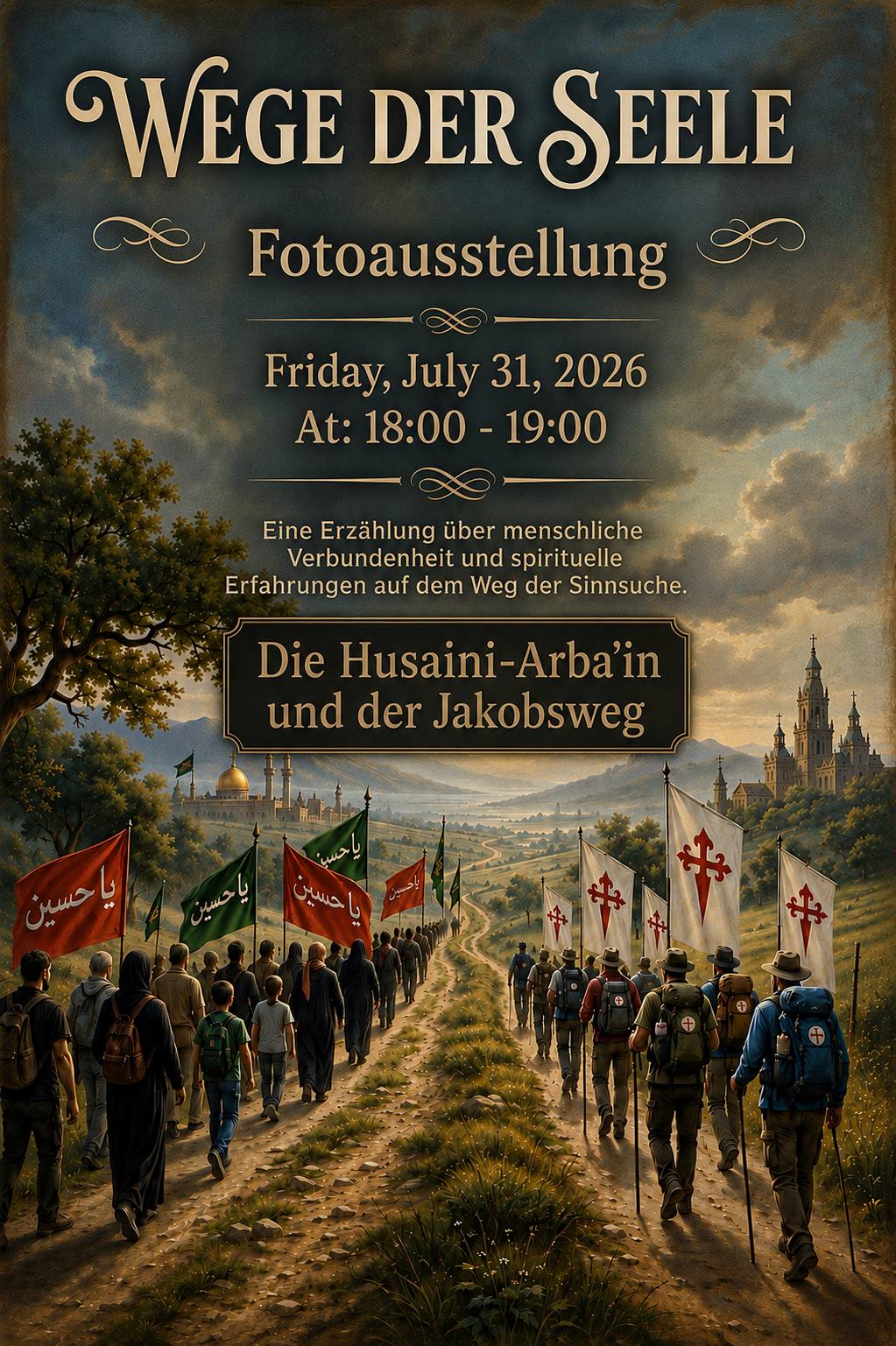
The “Paths of the Soul” photo exhibition, centered on comparing two great pilgrimage traditions—the Arbaeen Walk and the Christian pilgrimage of St. James (Camino)—was inaugurated on the evening of Friday, July 31, 2026 (9 Mordad 1405) at the Iranian Wisdom House in Vienna. This ceremony was held with the presence of a group of researchers, enthusiasts of interfaith and intercultural dialogue, representatives of scientific and cultural institutions, diplomats, and enthusiasts of religious studies, and was accompanied by the warm reception and active participation of the attendees. At the end of the speeches, a question and answer session was also held, which was welcomed by the participants.


At the beginning of the ceremony, Dr. Reza Gholami, the Cultural Attaché of the Islamic Republic of Iran in Austria and a professor of political philosophy, cultural, and civilizational studies, in a speech titled “Moving Towards the Divine Realm; A Journey for Self-Reflection, Spirituality, and Dialogue,” considered walking pilgrimages as one of the most valuable opportunities in human life to return to oneself, self-reflect, and strengthen the relationship with God.
Stating that in such journeys humans find the opportunity to distance themselves from the rush and noise of daily life and contemplate life’s most fundamental questions, he remarked: Religious pilgrimages are not merely a displacement in space, but are considered an inner journey to review the past, correct the future path, and rediscover the truth of human existence.
Emphasizing that true success is not summarized solely in attaining power, wealth, or material achievements, Dr. Gholami said: A successful effort is an effort that makes a human more ethical, kinder, more humble, more responsible, and more compassionate. He considered an ethical life as the path of divine proximity and added that walking pilgrimages are a practical exercise for virtues such as self-sacrifice, forgiveness, patience, empathy, and unconditional service to others.The Cultural Attaché of Iran in Austria described the massive Arbaeen Walk as one of the most prominent manifestations of human solidarity and ethical living in the contemporary world. Pointing to the annual presence of nearly twenty million pilgrims in this spiritual ritual, he said that the voluntary service, generosity, empathy, and hospitality of the Iraqi people toward millions of pilgrims is a rare example of the manifestation of ethical and religious values that can inspire today’s societies.


Continuing by referring to the pilgrimage route of St. James (Camino), he emphasized that although Arbaeen and the Camino are different historically, geographically, and in terms of religious traditions, both call the human being to search for meaning, truth, God, and the true self. According to him, religious differences are not an obstacle to dialogue, but an opportunity for a deeper understanding of one another and cooperation toward building a more ethical and spiritual world.
Dr. Gholami also emphasized the importance of holding such exhibitions in expanding the dialogue between Islam and Christianity and stated that juxtaposing the images of two great pilgrimage traditions is a reminder of the truth that a work of art can be a bridge between cultures and religions and provide the ground for mutual understanding.
In conclusion, he noted that the true value of a pilgrimage lies in the transformation that occurs within a human, and if a person returns kinder, more ethical, and more responsible after this journey, that pilgrimage has achieved its true mission.

Following this, Mr. Peter Haider, an experienced guide of the St. James pilgrimage route (Camino) and author of the book “1000 Kilometers to the West; On the Way of St. James to Reaching a New Self,” spoke about the historical background, spiritual dimensions, and his personal experience of this pilgrimage route.

Pointing out that the roots of the Way of Santiago date back to pre-Christian eras, he explained that this route has gone through various transformations throughout history and later became one of the most important pilgrimage routes in the Christian world. At the same time, taking a critical look, Haider pointed to certain historical periods in which the name of St. James was misused for political and military purposes, and emphasized that today this route has become a symbol of peace, tolerance, and coexistence among cultures and religions.
He noted that the Camino is no longer just a Christian pilgrimage; rather, human beings from various nationalities, cultures, and religions participate in it with diverse motivations. According to him, this path has turned into a school for learning tolerance, mutual respect, and understanding different ways of life, providing a valuable ground for dialogue among human beings.

Expressing his personal experience, Haider also stated that the beginning of this journey for him followed a spiritual crisis and occupational burnout, and traversing the eight-hundred-kilometer route of the Camino transformed his life. He emphasized that a long walk, after a few days, frees the human mind from the pressures of daily life and provides an opportunity to return to oneself, for deep reflection, and for spiritual reconstruction. He added that this experience reestablished a connection between him and spiritual and Christian values.
In another part of his speech, while pointing to the increasing number of pilgrims and tourists on the Way of St. James, he warned about the fading of its spiritual dimensions due to the expansion of tourism and emphasized the necessity of preserving the spiritual and cultural identity of this route. In conclusion, Haider considered holding the joint exhibition of Arbaeen and St. James a valuable initiative for strengthening dialogue among religions and clarified that both traditions, despite their historical and religious differences, call humans toward self-knowledge, truth, peace, and spiritual transcendence.
Among the special parts of this ceremony was the presence of Dr. Hisham Al-Alawi, the Ambassador of the Republic of Iraq in Austria, as a special guest. In his speech, while expressing gratitude to the organizers of this event, he emphasized the importance of holding such programs in introducing the cultural and human dimensions of the Arbaeen Walk and, referring to his personal experience of frequent attendance in this pilgrimage, he detailed its unique features.
The Iraqi Ambassador described the Arbaeen Walk as the largest annual human gathering in the world and said that every year more than twenty million people from across Iraq and dozens of countries around the world, from Asia, Europe, Africa, and the Americas, attend this ceremony, and its global scope is expanding every year.
Emphasizing that Arbaeen is not exclusively for Shiites, he noted that Muslims from different denominations, Iraqi and non-Iraqi Christians, as well as religious, cultural, and academic figures from various countries participate in this ceremony. According to him, in recent years, the Holy Shrine of Imam Hussein has provided the ground for the broader presence of world thinkers and religious leaders in this ritual by inviting prominent figures from different religions and nationalities.
Continuing, Dr. Al-Alawi, pointing to the inspiring experiences of non-Muslim participants, mentioned a British photojournalist who had attended the Arbaeen Walk for the first time to produce a photo report, but deeply influenced by the spiritual and human atmosphere of this ceremony, became one of its permanent enthusiasts. He also mentioned an Irish woman who had participated in this pilgrimage during her fight against cancer as an example of the profound spiritual and psychological effects of Arbaeen, saying that this experience gave her fresh hope and motivation and has led her to attend this ceremony every year.

The Iraqi Ambassador also considered the widespread presence of youth from various countries as one of the important features of the Arbaeen Walk and stated that the growing interest of the younger generation in understanding this cultural and spiritual phenomenon demonstrates Arbaeen’s high capacity to create connections between different cultures and generations.
In the final part of his speech, he considered the universal message of Imam Hussein (AS) to be beyond religious and geographical borders and listed the three fundamental principles of this message as taking responsibility in reforming society, safeguarding human dignity, and standing against oppression and injustice. Dr. Al-Alawi emphasized that these values belong to all human beings, and Arbaeen provides a platform for promoting kindness, generosity, mutual respect, coexistence, and social responsibility. He noted that the ultimate goal of this immense movement is to raise better humans and build a more humane and ethical world.

At the end of the ceremony, a question and answer session was held with the presence of the speakers, and the attendees raised their questions about the historical, cultural, social, and spiritual dimensions of the Arbaeen Walk and the St. James pilgrimage route. The provided answers, especially the Iraqi Ambassador’s explanations about the lived experience of the Iraqi people in hosting millions of pilgrims, were met with wide reception from the participants and created a sincere, academic, and dialogue-oriented atmosphere.

In this exhibition, 30 photographs from the works of prominent Arbaeen photographers and 10 photographs from the Christian pilgrimage of St. James (Camino) were put on display for the enthusiasts. Also, short films of both walks were screened for the attendees, which was accompanied by the reception of the audience and provided the ground for their greater familiarity with the spiritual, cultural, and human dimensions of these two great pilgrimage traditions. This exhibition was set up with the aim of strengthening dialogue among religions and cultures and introducing shared human values, including spirituality, service, solidarity, and peace.